

Generating $5,000 a month from your portfolio sounds like a goal reserved for retirees with seven-figure accounts. But with the right combination of income ETFs – particularly the new generation of options-based funds – you can build a portfolio that produces serious monthly cash flow on a surprisingly manageable investment base.
In this article, I'm going to break down exactly how to construct a 5-ETF income portfolio designed to hit that $5,000 monthly target, the logic behind each position, and the realistic tradeoffs you need to understand before you put any money to work.
Why Income ETFs Have Changed the Game
A few years ago, generating $5,000 a month in passive income required either a huge pile of dividend stocks with modest yields or high-risk bond plays. The math was brutal. At a 3% yield, you'd need over $2 million invested.
The rise of sophisticated options-income ETFs – particularly those built around covered call strategies and Section 1256 index options – has fundamentally changed that equation. Funds like SPYI and QQQI from NEOS Investments now offer yields in the 12-14% range while still maintaining meaningful equity exposure. That changes the portfolio math dramatically.
At a blended yield of roughly 11-12%, you can potentially hit $5,000 a month with an investment of around $500,000 to $545,000.
Let's Build That Portfolio.
The 5-ETF Portfolio
Here's the core lineup, with current approximate yields as of mid-2026:
| ETF | Name | Approx. Yield | Allocation |
| SPYI | NEOS S&P 500 High Income ETF | ~12% | 25% |
| QQQI | NEOS Nasdaq-100 High Income ETF | ~14% | 25% |
| GPIQ | Goldman Sachs Nasdaq-100 Core Premium Income ETF | ~11% | 20% |
| IWMI | NEOS Russell 2000 High Income ETF | ~14-15% | 15% |
| OVL | Overlay Shares Large Cap Equity ETF | ~9-10% | 15% |
Total portfolio target: $520,000
Blended estimated yield: ~12.2%
Estimated monthly income: ~$5,280
ETF #1: SPYI – Your Anchor (25% / $130,000)
SPYI is the foundation of this portfolio. It holds the S&P 500 and generates income by actively selling out-of-the-money index call options – a key distinction from simpler buy-write ETFs that cap all your upside.
What makes SPYI stand out is its use of Section 1256 index options. Under IRS rules, gains from these contracts are automatically taxed on a 60% long-term / 40% short-term split, regardless of your holding period. That's a structural tax advantage that most covered call ETFs simply don't have.
As of May 2026, SPYI carries a yield of approximately 12%, with most distributions classified as return of capital – meaning they're tax-deferred until you sell your shares. For income investors building taxable accounts, this matters enormously.
The role it plays: Stability. SPYI anchors the portfolio with broad S&P 500 exposure and dependable monthly distributions around $0.52 per share.
The tradeoff: Your upside is capped in strong bull markets. When the S&P 500 rips, SPYI will lag on total return – but it keeps writing those option premiums and delivering income every single month.
ETF #2: QQQI – Your Income Accelerator (25% / $130,000)
QQQI runs the same strategy as SPYI but targets the Nasdaq-100. Because the Nasdaq-100 is a more volatile index – dominated by mega-cap tech – there are larger option premiums to harvest, which translates into a higher yield.
As of mid-2026, QQQI's trailing yield sits around 13-14%, with distributions recently running around $0.63 per share per month. Like SPYI, it benefits from the Section 1256 tax treatment and has been recognized with the “Best New Active ETF” award at the 2025 ETF.com Awards.
The role it plays: Income amplification. QQQI gives you more income per dollar invested, at the cost of more tech-sector concentration.
The tradeoff: QQQI is more sensitive to Nasdaq drawdowns. In a sharp tech correction, you'll feel it more than in SPYI. Position sizing matters – keeping both at 25% each balances their complementary risk profiles without letting tech dominate.
ETF #3: GPIQ – The Institutional-Grade Nasdaq Income Play (20% / $104,000)
GPIQ is Goldman Sachs's answer to the high-yield Nasdaq income ETF category, and it brings something distinct to the table: institutional-quality options management from one of the most sophisticated derivatives desks on Wall Street.
GPIQ also focuses on the Nasdaq-100 but uses a more conservative call-writing approach than QQQI, which is why its yield – currently around 11% – is lower. But that conservatism also means more upside participation when the index runs. Think of it as a middle ground between the full income capture of QQQI and the growth participation of a pure equity fund.
GPIQ has grown rapidly, adding over $2.5 billion in assets in the past 12 months, which signals strong institutional and retail conviction in the strategy.
The role it plays: A Nasdaq income position with more growth participation. GPIQ complements QQQI rather than duplicating it – you get more Nasdaq-100 exposure but with a different risk/return tradeoff.
The tradeoff: Lower yield than QQQI. You're trading some income for more upside participation, which may or may not suit your goals.
ETF #4: IWMI – Small-Cap Income with the Highest Yield (15% / $78,000)
IWMI (NEOS Russell 2000 High Income ETF) is the highest-yielding fund in this portfolio, currently running around 14-15%. It applies the same NEOS options strategy to the Russell 2000 – the small-cap benchmark – which historically carries even higher volatility than the Nasdaq-100, and therefore even richer option premiums.
This is a smaller allocation (15%) precisely because small-cap ETFs carry higher risk. The Russell 2000 is more sensitive to economic cycles, interest rate changes, and domestic economic conditions. In a risk-off environment, small caps tend to sell off harder.
The role it plays: Yield enhancement. That 14-15% yield on a 15% portfolio allocation pulls up the blended portfolio yield meaningfully, helping you hit the $5,000/month target with a smaller total investment.
The tradeoff: Volatility and NAV sensitivity. You need to be comfortable with the fact that IWMI can decline more sharply in a downturn than your S&P 500-anchored positions.
ETF #5: OVL – The Growth Kicker (15% / $78,000)
OVL (Overlay Shares Large Cap Equity ETF) takes a different approach from the pure option-income funds above. It holds large-cap equities – essentially S&P 500 exposure – and overlays a fixed income strategy to generate additional yield. The result is a fund with a yield currently around 9-10% and stronger equity appreciation potential than the heavy-call-writing funds.
OVL pays monthly distributions and has demonstrated solid NAV stability compared to higher-yielding covered call ETFs. It's the “growth bridge” in this portfolio – the position most likely to appreciate in capital value over time while still delivering meaningful income.
The role it plays: Capital preservation and growth. OVL's lower yield is offset by stronger potential for NAV appreciation, which matters a lot for the long-term health of a portfolio built on monthly income.
The tradeoff: The lowest yield in the lineup. If your only goal is maximum income in the near term, OVL is the easiest to swap out. But if you're thinking about the next 5-10 years, that equity growth component becomes increasingly valuable.
Running the Numbers: How to Hit $5,000/Month
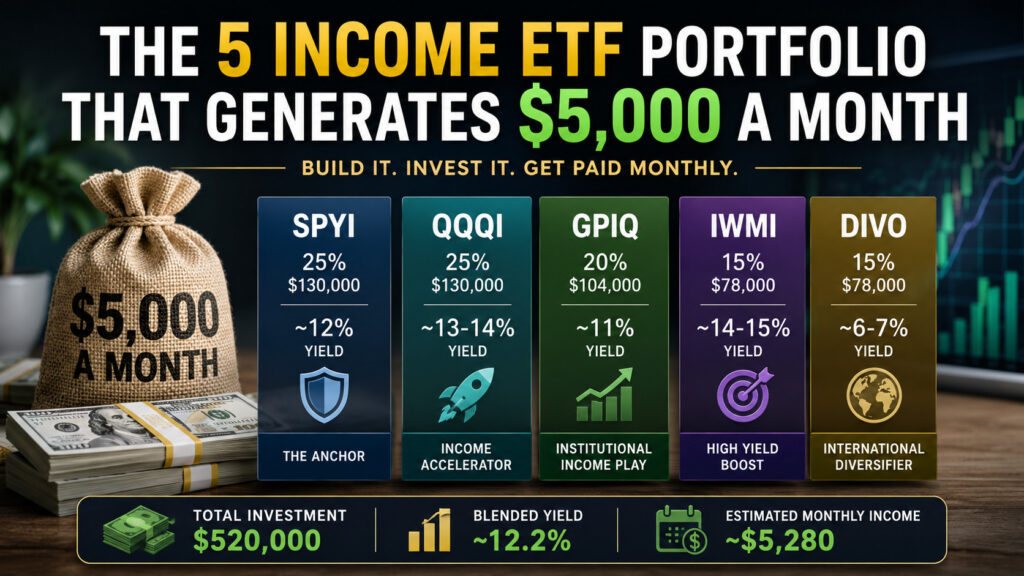
Here's how the math works across the portfolio, using conservative yield estimates:
| ETF | Allocation | Yield (est.) | Annual Income | Monthly Income |
| SPYI | $130,000 | 12% | $15,600 | $1,300 |
| QQQI | $130,000 | 13.5% | $17,550 | $1,463 |
| GPIQ | $104,000 | 11% | $11,440 | $953 |
| IWMI | $78,000 | 14.5% | $11,310 | $943 |
| OVL | $78,000 | 9.5% | $7,410 | $618 |
| Total | $520,000 | ~12.2% | $63,310 | $5,276 |
A $520,000 portfolio, distributed across these five ETFs, is projected to generate approximately $5,276 per month – comfortably clearing the $5,000 target.
If you're working toward this goal, a $400,000 portfolio would produce around $4,060/month at the same blended yield. A $600,000 portfolio would push you toward $6,100/month.
What You Need to Understand Before Investing
1. These yields are not guaranteed
Option premiums fluctuate with market volatility. In a low-volatility environment, distributions can decline. All five funds have shown consistent monthly payments, but no income ETF can guarantee a fixed distribution indefinitely.
2. NAV erosion is a real risk
High-yield covered call ETFs can experience gradual NAV decline over time if market conditions are unfavorable. The Section 1256 structure and partial call-writing approach of SPYI and QQQI help mitigate this – but it's never zero. Monitor your NAV, not just your yield.
3. Tax treatment varies by fund
SPYI and QQQI's Section 1256 advantage is significant – 60% of option gains taxed at long-term rates. OVL and GPIQ have different tax profiles. If you're building this in a taxable account, work with a tax professional to understand the full picture. In a Roth IRA or 401(k), tax treatment is irrelevant.
4. This is an income-first portfolio
This portfolio is built to generate cash flow. It will likely underperform a pure equity index like the S&P 500 in a strong bull market. If your goal is maximum long-term total return, a growth-heavy portfolio is more appropriate. If your goal is reliable monthly income – for living expenses, reinvestment, or supplementing other income streams – this portfolio is designed for that.
5. Diversification within income matters
Spreading across five different fund structures – NEOS index options, Goldman Sachs managed options, Overlay Shares fixed income overlay – means you're not entirely dependent on one strategy or one fund manager's execution. That's intentional.
Who This Portfolio Is For
This 5-ETF income portfolio makes the most sense for:
- Investors in or near retirement who want predictable monthly cash flow without selling shares
- Semi-retired or part-time workers supplementing earned income with portfolio income
- Investors building toward financial independence who want to see a real income floor from their portfolio
- Taxable account investors who benefit from the Section 1256 tax treatment of SPYI and QQQI
It is probably not right for investors with a 20+ year time horizon who have no near-term income need and are focused purely on wealth accumulation.
The Bottom Line
Generating $5,000 a month from a portfolio is achievable – not just for ultra-wealthy retirees, but for any investor willing to build a thoughtful income strategy around modern ETFs. SPYI, QQQI, GPIQ, IWMI, and OVL represent five different flavors of income generation, from the gold-standard NEOS index option approach to Goldman Sachs's institutional overlay to the small-cap volatility premium of IWMI.
At a combined $520,000 investment with a blended yield around 12%, this portfolio targets $5,276 per month in distributions – every single month, hitting your account like clockwork.
If you're not yet at $520,000, that's fine. The same framework scales down. Start with SPYI and QQQI as your core, add GPIQ for diversification, and build from there. The important thing is understanding the strategy, not the dollar amount.

I’m Steve. I’m an English Teacher, traveler, and an avid outdoorsman. If you’d like to comment, ask a question, or simply say hi, leave me a message here, on Twitter (@thefrugalexpat1). Many of my posts have been written to help those in their journey to financial independence. I am on my journey, and as I learn more I hope to share more. And as always, thanks for reading The Frugal Expat.