
Why sell shares when you could own an ETF that pays you every month? I’ve been looking hard at living off portfolio income instead of selling, and one ETF tops my list: OVL. I have over $10,000 in it, I keep adding, and those monthly payouts hit my account like clockwork, all while it tracks the S&P 500.
VOO and Chill, or OVL and Chill?
You've probably heard the phrase “VOO and Chill.” Buy the S&P 500, reinvest, and let time do the heavy lifting. It's simple, cheap, and it works.
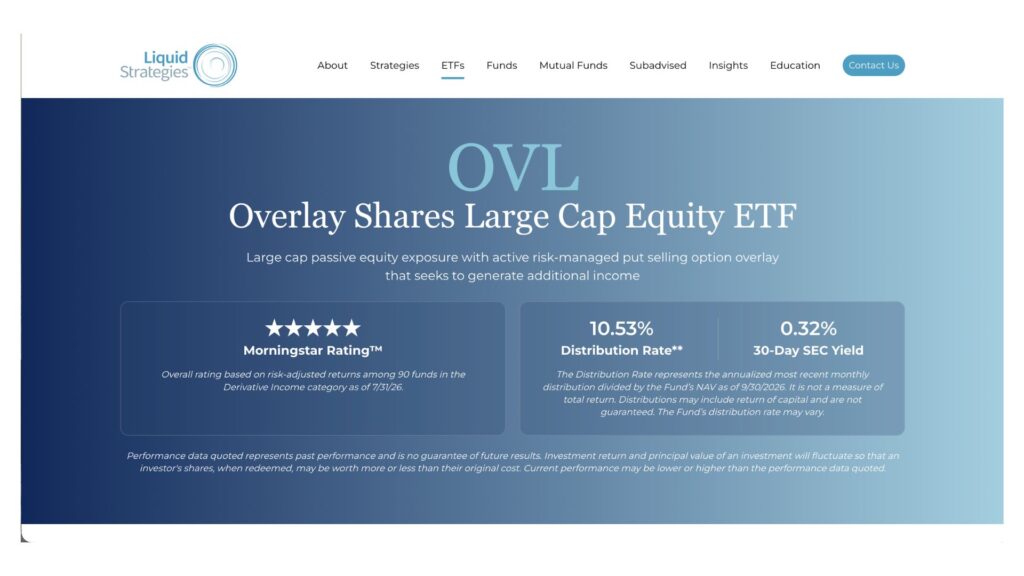
But what if you could own that same S&P 500 exposure, collect around 10% in monthly income, and still keep pace with (or even beat) VOO? That's the pitch behind OVL, the Overlay Shares Large Cap Equity ETF from Liquid Strategies.
I'm not just writing about this one. I own OVL myself, I have over $10,000 invested, and I keep adding to my position. Those monthly dividends land in my account like clockwork. In this post I'll break down how OVL works, how it has performed against VOO, and why I think it can serve as the core of an income portfolio.
Why so Many Investors Want to Own the S&P 500
Before we get to the options strategy, it's worth remembering why the S&P 500 is the foundation of so many portfolios:
- Instant diversification. One fund gives you roughly 500 of the largest US companies across every major sector.
- Self-cleaning index. Companies that shrink get dropped, and the next generation of winners gets added. You don't have to pick them.
- Long track record. Over decades, the index has rewarded patient investors who stayed invested through the downturns.
- Low maintenance. No stock picking, no earnings-season stress. You buy it and keep buying it.
The one thing the S&P 500 doesn't give you is much income. VOO's dividend yield is only around 1%. That's fine when you're building wealth, but it's a problem when you want your portfolio to pay your bills. That's the gap OVL is designed to fill.
What OVL is and How the Options Strategy Works
OVL launched on September 30, 2019, and its structure is refreshingly simple. Look at the holdings and you'll see roughly 100% of the fund sitting in one position: VOO, the Vanguard S&P 500 ETF. On top of that, the managers run an options “overlay” to generate extra income.
Here's how that overlay works, step by step:
- Own the S&P 500. The fund holds VOO, so you get the full ride of the index, up and down.
- Sell a put on the S&P 500 index. OVL sells short-dated index puts (often expiring within days) slightly below where the market is trading. Selling the put brings in cash premium.
- Buy a lower put for protection. At the same time, it buys a put with a lower strike price. This turns the trade into a put spread and caps how much any single trade can lose.
- Keep the difference. If the S&P 500 stays above the short strike at expiration, both puts expire worthless and OVL keeps the net premium. That premium funds the monthly distribution.
- Repeat. The fund rolls these spreads continuously, with notional exposure of up to 100% of the fund's net assets.
Why this matters: Most covered call ETFs sell calls against their holdings, which caps your upside when the market rips higher. OVL sells puts instead and never sells away the VOO shares. That's why it can keep up with the S&P 500 in strong markets while still paying a double-digit yield.
Helpful hint: Think of OVL as “VOO plus a side hustle.” The VOO does the growing, and the put spreads try to pay the bills.
OVL vs VOO: the performance numbers
Here's where OVL really stands out. Since its launch in late 2019, OVL has delivered a total return of about +208.6%, compared with +189.3% for VOO, based on Stock Analysis data as of October 2026.
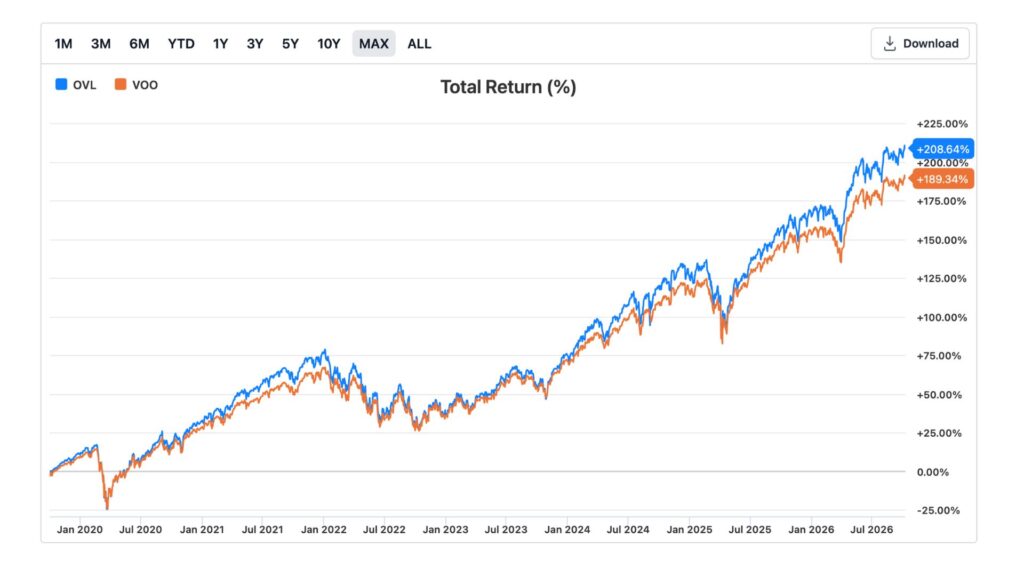
It's not a one-off, either. According to Liquid Strategies, OVL has beaten the S&P 500 Total Return Index over every standard time frame through September 30, 2026:
| Period (annualized beyond 1 yr) | OVL (NAV) | S&P 500 TR |
|---|---|---|
| 1 year | 18.11% | 15.74% |
| 3 years | 24.81% | 22.89% |
| 5 years | 14.01% | 13.79% |
| Since inception (Sep 2019) | 16.96% | 16.17% |
Source: Liquid Strategies OVL fund page. OVL also carries a 5-star overall Morningstar rating in the Derivative Income category (90 funds, as of July 31, 2026).
The margins aren't huge, but that's the point. You're getting S&P 500-like growth plus a 10% income stream, not trading one for the other.
10% Income, Paid Every Month
OVL's current distribution rate is about 10.5%, and since January 2026 it pays monthly (it used to pay quarterly). The September 2026 payout was $0.4935 per share.
Here's what that looks like on $10,000, roughly what I have in it:
- At about $57.42 per share, $10,000 buys around 174 shares.
- 174 shares × $0.4935 = roughly $86 per month.
- That's a little over $1,000 a year in income from a fund that's tracking the S&P 500.
The payout has also grown. In 2023, OVL paid around $0.30 per share per quarter. Today it pays about $0.49 per share per month.
What if you reinvest?
I ran $10,000 through DRIPCalc with dividends reinvested for 20 years. Using its assumptions of 10% annual growth in both the share price and the dividend, it projects an ending balance of about $474,859 and annual income of nearly $39,000 by year 20.
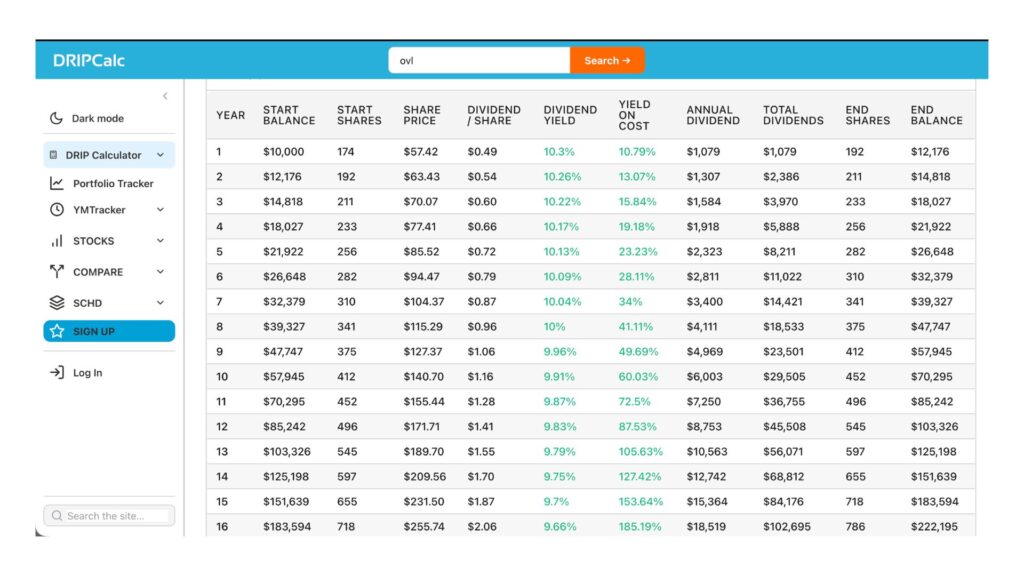
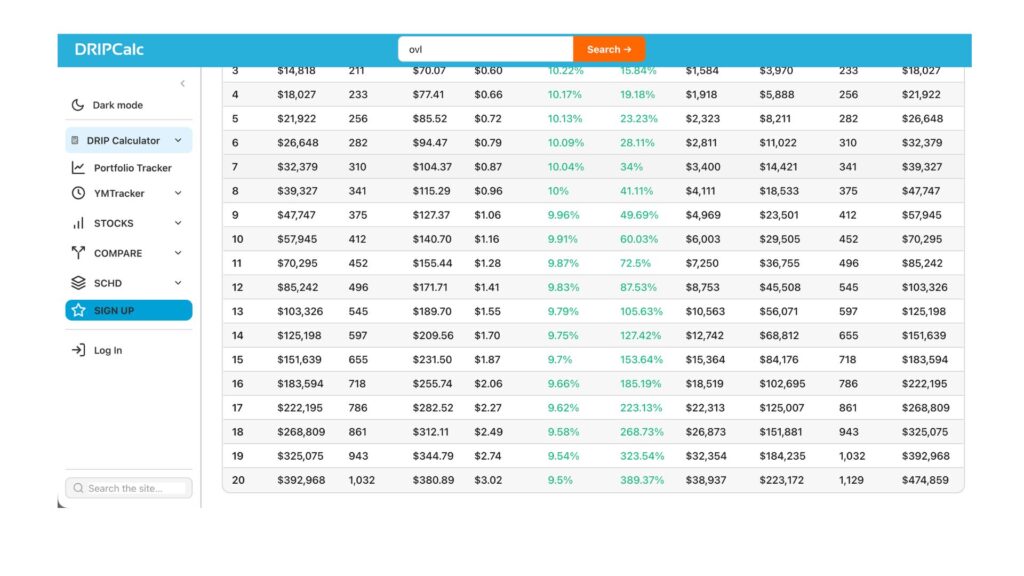
Treat that as a “what if,” not a forecast. Ten percent dividend growth every single year is an optimistic assumption, and option income rises and falls with market volatility. The real lesson is the shape of the curve: reinvested monthly income snowballs.
Why OVL can be Tax Efficient
A 10% yield doesn't help much if a big chunk goes to taxes. OVL has two structural advantages in a US taxable account:
- Section 1256 treatment. OVL trades options on the S&P 500 index, which are generally treated as Section 1256 contracts. Gains and losses on those are typically taxed 60% long-term and 40% short-term, regardless of how long the position was held. That's usually friendlier than ordinary income.
- Return of capital. Liquid Strategies estimates that its 2026 distributions so far have been 100% return of capital (ROC). ROC isn't taxed when you receive it. Instead, it lowers your cost basis, which pushes the tax bill out until you sell.
Two caveats worth knowing. First, ROC is a deferral, not a free pass: a lower cost basis means a bigger capital gain when you eventually sell. Second, the final tax breakdown is only set after the fund's fiscal year ends, so check your 1099 and the fund's Section 19(a) notices.
Helpful hint: If you're investing from outside the US (like me in Australia), the tax treatment can look very different. Talk to a tax professional in your country before buying.
Great for Retirees, and a Solid Portfolio Core
For retirees, OVL checks a lot of boxes:
- Monthly paychecks. Income lines up with monthly bills, which makes budgeting in retirement much easier.
- No need to sell shares. A 10% distribution can cover spending without trimming your holdings in a down market.
- Growth still matters. Retirement can last 30 years. Because OVL keeps full S&P 500 exposure, your portfolio isn't stuck in a low-growth income fund.
As a portfolio core, OVL works because the engine underneath is the S&P 500. You can build around it the same way you'd build around VOO, then add satellites for the things the S&P 500 doesn't cover well:
- Nasdaq 100 income for extra tech growth
- Small-cap income for size diversification
- International income for exposure outside the US
- Sector or bitcoin income for a smaller, higher-risk sleeve
That's exactly why I keep adding to my own position. OVL is the steady center of my income portfolio, and the monthly dividends give me cash to reinvest or put to work elsewhere.
Risks to Know Before you Buy
No ETF is perfect, and OVL has trade-offs:
- Sharp sell-offs hurt more. In a fast drop, the short puts lose money on top of the VOO decline, so OVL can fall harder than the S&P 500 for a stretch.
- Higher fees. OVL's expense ratio is 0.79%, versus a few hundredths of a percent for VOO.
- Income isn't guaranteed. Option premium depends on market conditions, so the payout can change month to month.
- Smaller fund. OVL has about $490 million in assets, a fraction of VOO's size.
Helpful Hints for Owning OVL
- Turn on DRIP while you're building. If you don't need the income yet, reinvesting the monthly payouts accelerates the snowball.
- Track your cost basis. With return of capital, your basis drops over time. Keep records so tax time isn't a surprise.
- Add on red days. Market dips are when OVL lags most, which can make them good moments to add shares.
- Don't go all-in on one fund. Use OVL as a core and pair it with a few satellites rather than holding it alone.
- Look at total return, not just yield. A high yield only matters if the share price holds up. OVL's record on both is what makes it stand out.
The Bottom Line
OVL gives you what most investors want from the S&P 500, broad diversification and long-term growth, while paying roughly 10% a year in monthly income. It has outpaced VOO since inception, it can be tax efficient, and it makes a strong core for an income portfolio. That's why I own it, and why I keep adding to it.
Disclaimer: This post is for educational purposes only and is not financial or tax advice. Past performance does not guarantee future results. Do your own research or consult a licensed professional before investing.
Sources
- Liquid Strategies: OVL fund page (distribution rate, performance, holdings, tax notes; data as of Sep 30 to Oct 9, 2026)
- Stock Analysis: OVL vs VOO comparison (total return since inception)
- DRIPCalc: OVL (20-year DRIP projection)

I’m Steve. I’m an English Teacher, traveler, and an avid outdoorsman. If you’d like to comment, ask a question, or simply say hi, leave me a message here, on Twitter (@thefrugalexpat1). Many of my posts have been written to help those in their journey to financial independence. I am on my journey, and as I learn more I hope to share more. And as always, thanks for reading The Frugal Expat.