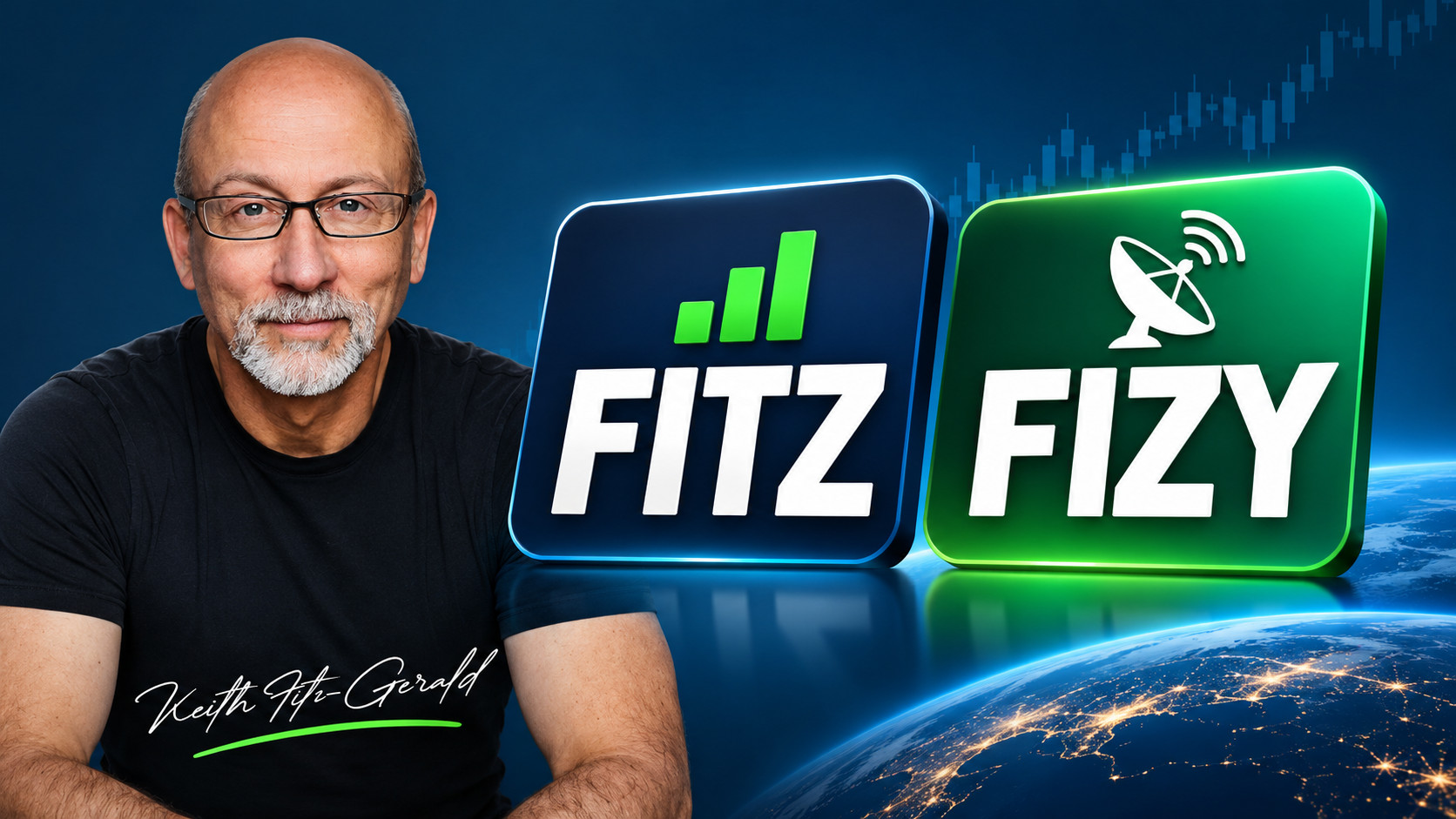
FITZ and FIZY hold the same idea in two wrappers: about 30 “must have” companies picked by Keith Fitz-Gerald. FITZ is the growth version. FIZY adds an options overlay to pay you weekly.
Keith has spent 45 years as a global investor, researcher and strategist. He publishes 5 with Fitz and One Bar Ahead, and he's a regular collaborator with Suze Orman. In 2026 he partnered with XFUNDS (David Nicholas's shop, the team behind BLOX, GIAX and DRMY) to turn his research into two actively managed ETFs:
- FITZ — Fitz-Gerald Must Have Portfolio ETF, launched May 27, 2026
- FIZY — Fitz-Gerald Must Have Portfolio and Options Overlay ETF, launched August 4, 2026
Both are built on one belief: conventional diversification manages fear rather than capturing growth. Below I break down how each fund works, what Keith has said about the companies inside them, the pros and cons, and who each one is really for.
I'll be sitting down with Keith for an interview on the channel soon, so if you have questions for him, leave them in the comments.
FITZ: The Concentrated Growth Fund
FITZ owns 20 to 30 companies Keith believes the world can't live without, and holds them for five to ten years. There's no options overlay and no meaningful yield. This is a total-return fund.
The thesis. Keith points to research showing that roughly 4% of all US-listed companies created essentially all of the stock market's wealth over the past century, while the other 96% did no better than Treasury bills. His conclusion: owning hundreds of stocks doesn't lower your risk so much as dilute you into the average. He also argues passive flows, zero-DTE options, ETF cross-ownership and 24-hour trading have made stocks move together, so diversification fails exactly when you need it (Behind the Ticker).
The 5 D's. Every holding has to line up with at least one of five structural themes (StockAnalysis):
- Digitalization — the master theme. Keith says it's now so big it covers every other theme.
- Defense — defense and security, physical and cyber.
- Diffusion — new technology spreading into more industries.
- Distribution — modern delivery and logistics.
- Dislocation — companies that benefit from major economic shifts.
The must-have filter. Beyond the themes, Keith looks for a visionary CEO, a strong balance sheet, strong free cash flow, multiple “zero to one” catalysts, and no easy substitute for the product. His shorthand: Apple vs. Peloton, Walmart vs. Kroger.
Selling and rebalancing. FITZ rebalances three times a year instead of quarterly. Keith says trading on the same quarterly calendar as everyone else creates a real drag from poor fills. A stock only leaves when the original reason for owning it is gone.
| Detail | FITZ |
| Full name | Fitz-Gerald Must Have Portfolio ETF |
| Launched | May 27, 2026 |
| Expense ratio | 0.75% |
| Holdings | About 30 (32 as of late Oct 2026) |
| Assets | Crossed $100M in Oct 2026 |
| Rebalancing | Three times a year |
| Distributions | Minimal — one $0.058 dividend in Sep 2026 |
| Price | About $25 at launch, $26.21 on Oct 23, 2026 |
Top 10 holdings (as of Oct 23, 2026): Palantir 6.2%, Apple 4.9%, CrowdStrike 4.9%, Chevron 4.7%, Nvidia 4.7%, Eli Lilly 4.5%, Walmart 4.4%, JPMorgan 4.4%, AbbVie 4.2%, Microsoft 4.2%. The top 10 make up about 47% of the fund (StockAnalysis). Other names in the portfolio have included Tesla, AMD, RTX, Lockheed Martin, GE Vernova, Broadcom, IonQ and CareTrust REIT (Equibles).
Notice the mix. This isn't a tech fund in disguise: oil (Chevron), banking (JPMorgan), pharma (Lilly, AbbVie), defense (RTX, Lockheed) and retail (Walmart) all sit next to AI names.
FIZY: The Same Companies, Paid Weekly
FIZY holds 15 to 30 of the same kind of must-have stocks, then sells options on them to pay a weekly distribution. Its primary objective is current income; growth is secondary (Business Wire).
How the overlay works. FIZY doesn't run one fixed covered call strategy. The team can use any mix of:
- Covered calls on stocks the fund owns
- Cash-secured puts on stocks it would like to own
- Call and put credit spreads
The mix shifts with market conditions and volatility, and the positions are actively monitored. The fund also holds cash and short-term Treasuries as collateral, which adds a bit of interest income. If you've followed my put credit spread videos, this toolkit will look familiar — it's much more flexible than a plain covered call ETF.
Keith's pitch for it: FIZY takes the companies he has spent a career identifying and tries to put cash in investors' pockets every week for owning them.
| Detail | FIZY |
| Full name | Fitz-Gerald Must Have Portfolio and Options Overlay ETF |
| Launched | August 4, 2026 |
| Expense ratio | 1.01% |
| Stocks held | 15 to 30 (plus options positions) |
| Assets | About $11.6M |
| Distributions | Weekly, $0.068 to $0.072 per share since launch |
| Distribution rate | About 15.2% |
| Total return since launch | −3.1%, vs. −4.7% for SPY |
| Price | $24.28 on Nov 5, 2026 |
Figures as of Nov 5, 2026 (Dividend Vision).
Two things stand out. First, the weekly payout has been remarkably steady — every payment so far sits within a few tenths of a cent of $0.07. Second, in a rough patch for the market since August, FIZY has lost less than SPY on a total-return basis. That's only three months of data, so don't read too much into it.
Top holdings have looked a lot like FITZ: Palantir, Nvidia and Apple led the fund in mid-September at roughly 5.5% to 6.2% each, with CrowdStrike and Chevron close behind (MarketXLS). FIZY has also held a few names FITZ doesn't lead with, including ExxonMobil, Kinder Morgan, Costco and Amazon.
What Keith Has Said About the Companies
Keith is very public about his picks, and his reasoning is consistent: he looks past the label Wall Street puts on a company to the business it's actually becoming. His tagline sums it up: “Buy the Best, Ignore the Rest.”
| Company | Keith's take | Where he said it |
| Palantir (PLTR) | The fund's largest holding. When the stakes are a battlefield, a hospital or a supply chain, “mostly right” isn't good enough, and that's when customers call Palantir. He says analysts are only now catching up to what he's known for a while. | X, Nov 2, 2026 |
| Apple (AAPL) | Not a phone company. He saw the iPhone as an ecosystem and a revenue platform, and points to Services as the high-margin business people ignore while they fixate on unit sales. He called Apple a buy near $172 in April 2025. | Behind the Ticker; MoneyShow via Muck Rack |
| Walmart (WMT) | One of the most important tech companies in the world. Digitalization changed its purchasing, pricing, inventory and customer loyalty, and it's expanding into AI, membership and payments. A sector-based fund would file it under retail and miss that. | Behind the Ticker |
| Tesla (TSLA) | He expects cars to become Tesla's least profitable business within a few years, with robotics, data and energy taking over. In March 2026 he highlighted the Cybercab line moving into higher-volume test production. | Behind the Ticker; MoneyShow via Muck Rack |
| Nvidia (NVDA) | He backed Jensen Huang's plan to build $500 billion-plus in AI financing platforms with big money managers, and dismissed the “circular financing” criticism. His argument: customers need more chips than they can pay for in cash. | MoneyShow via Muck Rack (Aug 2026) |
| CrowdStrike (CRWD) | After a June 2026 beat sent shares lower anyway, he told investors not to let fast-money traders shake them out of a winner. | MoneyShow via Muck Rack |
| Energy (Chevron, Exxon) | In May 2026 he pointed to energy as an opportunity while fear about the Fed, Iran and inflation dominated headlines. | MoneyShow via Muck Rack |
| Micron (MU) | After a blowout quarter in October 2026, he warned traders about the post-earnings head fake he'd flagged ahead of time. Memory is a big theme for him. | MoneyShow via Muck Rack |
| Intel (INTC) | The clearest example of his sell discipline. Intel missed every major shift, and when it cut its dividend he sold and moved into Nvidia, AMD or Palantir. He doesn't think Intel would survive without the US government's stake. | Behind the Ticker |
| Oracle (ORCL) | Mixed. He praised Oracle in 2025 as proof that AI was being monetized, but in March 2026 he wasn't convinced its AI pivot of the Fusion cloud suite made it a buy. | MoneyShow via Muck Rack |
The highlighter test. When people question a holding, Keith hands them the list of 30 names and a highlighter and asks them to cross off any company they wouldn't want to own in 10 years, and explain why. He says that almost always, nobody can. Usually the objection comes down to not liking Elon Musk or Jamie Dimon, not the business.
Pros and Cons
The biggest trade-off is the same for both: you're paying active-management fees for one person's conviction, with only months of track record to judge it.
FITZ
Pros
- Real conviction. About 30 names, each around 4% to 6%. If Keith is right, the winners actually move your portfolio.
- More than a tech fund. Energy, banks, pharma, defense and retail sit alongside AI, so it's not just another Nasdaq-100 clone.
- Clear sell discipline. Stocks leave when the thesis breaks, as Intel did.
- Low turnover. Three rebalances a year, with a five- to ten-year holding mindset.
- Gaining traction. It crossed $100 million in assets in about five months.
Cons
- Fees. 0.75% vs. 0.03% for an S&P 500 index fund. Morningstar's Brendan McCann noted that's roughly a 70-basis-point hurdle every year (The Daily Upside).
- Concentration cuts both ways. McCann also pointed out these funds can wildly underperform, and only 38% of active funds beat their passive peers last year.
- More volatile than the S&P 500. Keith says this himself.
- Key-person risk. The fund is Keith's framework. If his calls go cold, there's no index to fall back on.
- Tough start. Keith admits FITZ launched at the market peak. It's been roughly flat to slightly up since.
- No income. Basically zero yield, so it's not for anyone who needs cash flow.
FIZY
Pros
- Weekly income. About $0.07 per share every week, a distribution rate near 14%.
- Steady so far. Every payment since launch has been between $0.068 and $0.072.
- Flexible overlay. Covered calls, cash-secured puts and credit spreads give the team more tools than a standard covered call fund, and they can adjust to volatility.
- Same must-have companies. You get Keith's stock picks with a paycheck attached.
- Held up better than SPY in its first three months (−3.1% vs. −4.7% total return).
Cons
- Higher fee. 1.01%, the price of the options work on top of active stock picking.
- Small fund. About $11.6 million in assets. Smaller funds can have wider spreads and a higher risk of closure.
- Capped upside. Selling calls means FIZY will likely trail FITZ in strong rallies.
- Price drift to watch. It launched near $25 and closed at $24.28 on Nov 5. Some of that is the market, but a 15% payout needs real total return behind it, or NAV erodes over time.
- Unproven. Dividend Vision rates its distribution 50/100, “unproven,” simply because there isn't enough history (Dividend Vision).
- Tax treatment. Option-driven distributions are often taxed as ordinary income in a taxable account, so FIZY likely fits best in an IRA or other tax-advantaged account. Check the fund's 19a-1 notices for any return of capital.
Who Each ETF Is Meant For
FITZ is for investors building wealth who can ride out volatility. FIZY is for investors who want Keith's companies but need the income now.
FITZ works best for:
- Younger investors and long-term accumulators. Keith specifically mentions young professionals who want to own companies that will be around for decades.
- Pre-retirees and retirees chasing growth. He also pitches it to people nearing retirement who still want high return potential.
- Anyone looking for a core equity holding. Keith designed FITZ as a main course, not a side dish. Advisors can build around it, use it for specific theme exposure, or even use it in place of a 60/40 mix.
- Investors who are tired of owning 500 stocks to get the 30 that matter.
Keith's own advice on getting in: dollar-cost average. He told ETF Upside that with current volatility, he wouldn't put everything in at once (The Daily Upside).
FIZY works best for:
- Income investors and retirees who want a weekly paycheck from high-quality, growth-oriented companies instead of a broad index.
- Covered call ETF owners who want more active management. FIZY's overlay can switch between calls, puts and spreads, unlike a fixed overwrite strategy.
- People who believe in the must-have thesis but can't afford to wait 5 to 10 years for it to play out without cash flow.
| FITZ | FIZY | |
| Main goal | Long-term growth | Current income |
| Expense ratio | 0.75% | 1.01% |
| Income | Minimal | About 15% rate, weekly |
| Upside in a rally | Full | Partly capped by options |
| Best account | Taxable or retirement | Tax-advantaged |
| Best for | Accumulators, core holding | Retirees, income seekers |
Can you own both? Yes. They hold largely the same companies, so think of it as a dial. More FITZ while you're accumulating, shifting toward FIZY as you need the income. Just don't treat owning both as diversification — you're doubling down on the same 30 names.
The Bottom Line
FITZ and FIZY are a bet on one idea: that a few dozen must-have companies will beat the market, and that Keith Fitz-Gerald can pick them. If you buy that thesis, FITZ is the purer, cheaper way to own it, and FIZY is the way to get paid weekly while you wait.
Both funds are only months old. FITZ has gathered over $100 million quickly, and FIZY's weekly payouts have been impressively consistent, but neither has been through a full market cycle. If you're interested, Keith's own advice is a good one: start small and dollar-cost average in.
I'll be asking Keith about all of this — including how FIZY decides between calls, puts and spreads, and how he'd split money between the two funds — in my upcoming interview. Drop your questions in the comments.
Disclaimer: This post is for educational purposes only and is not financial advice. I'm not a licensed financial advisor. Do your own research and read each fund's prospectus before investing. Data is as of the dates noted and will change.
Sources
- XFUNDS and Keith Fitz-Gerald Launch FITZ — Business Wire
- XFUNDS Adds Weekly Income ETF FIZY — Business Wire
- Keith Fitz-Gerald on Behind the Ticker — THOR Financial Technologies
- Keith Fitz-Gerald's New ETF Is Betting Against Diversification — The Daily Upside
- FITZ overview — StockAnalysis
- FITZ holdings — Equibles
- FIZY distributions and performance — Dividend Vision
- FIZY holdings — MarketXLS
- Keith Fitz-Gerald's MoneyShow articles — Muck Rack
- Keith Fitz-Gerald on Palantir — X

I’m Steve. I’m an English Teacher, traveler, and an avid outdoorsman. If you’d like to comment, ask a question, or simply say hi, leave me a message here, on Twitter (@thefrugalexpat1). Many of my posts have been written to help those in their journey to financial independence. I am on my journey, and as I learn more I hope to share more. And as always, thanks for reading The Frugal Expat.